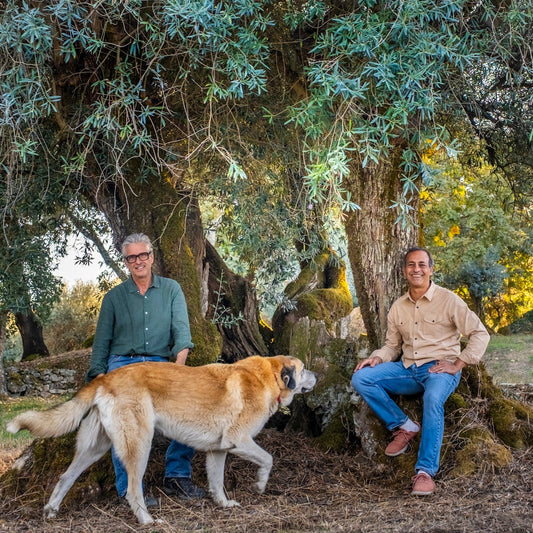
Some olive groves are old. Cláudia and Miguel Villax's is older than Portugal. On the slopes of the Serra de São Mamede, below the walled hilltop village of Marvão, they run the oldest organic olive farm in the area. Some of its trees are believed to date to the 8th century. They were already growing when Ibn Marwan, a 9th-century rebel lord, fortified the crag above them and gave Marvão its name, and they were old by the time Portugal became a kingdom in 1143.

The hilltop fortress of Marvão
I first tasted their oil thanks to a mutual friend, who gifted me a small flask. As a sommelier, I knew right away it was something special.
Cláudia and Miguel took over the farm in 2003. Cláudia came to it from the world of food and publishing, Miguel from technology. Cláudia co-founded the Portuguese magazines Blue and Blue Cooking, and later opened A Sociedade, a gathering place for chefs and food lovers in Lisbon. They farmed organically from the very first day, partly so their children would grow up close to the land. As Cláudia puts it, "soil is part of us."
Walk the grove with them and you see how much work that takes. The first time we visited, their son was home from university, hauling pruned branches down the hillside by hand. The slopes are too steep for vehicles to reach most of the trees, so nearly everything here is done on foot.
Some of the oldest trees carry names of historical figures, to show how far back they reach. Charlemagne, pictured below, is believed to have taken root in the 700s and served as their kids' treehouse when they were younger.

"Charlemagne," an ancient tree in their grove
It is quite rare for a farm this small to maintain its own mill. Cláudia and Miguel built one anyway, because they are dedicated to making the best possible oil from these trees, and that meant pressing it themselves as soon as possible. They did it their own way, too: housed in pine instead of steel and concrete, and run on solar power.

Trees this old outlive everyone who tends them. The first time we met Cláudia and Miguel, they made it clear they don't think of the grove as theirs. They see themselves as its current stewards, the latest in a long line of people who have cared for these trees, and not the last.
Their ancestral blend of sweet Galega and peppery Cordovil became our Thousand Year Special Reserve.
5% of all profits from selling their oil is returned to them to help care for these ancient trees.